The Direction Provenance Model (DPM) v2.1


A Framework for Human Authorship in AI-Assisted Work
The Direction Provenance Model is a publicly auditable framework for locating and documenting human authorship within AI-assisted creation. As visual outputs become abundant and instantaneous, the DPM places authorship in the human decisions that structure, constrain, direct, and commit a work. Value does not come from volume or replication. It comes from directional human labor, and that labor is made traceable.
This is version 2.1. The original framework, v1.0, was published as a permanent provenance record on Ethereum at the moment of its discovery. That record stands unchanged. It marks where the model began. This version reflects what the practice has taught since.
What changed from v1.0, and why it had to
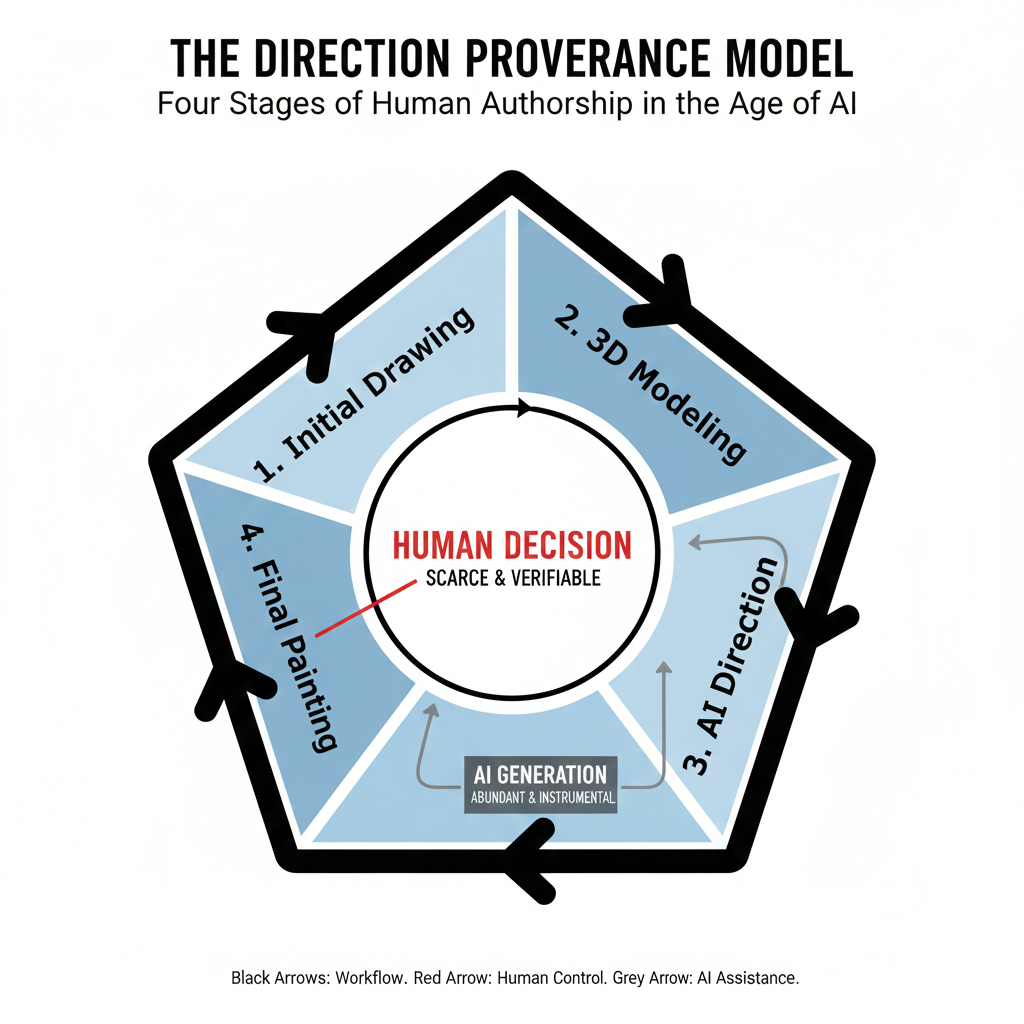
Version 1.0 described the DPM as a four-stage cycle, in order: drawing, then 3D model, then AI direction, then painting. That sequence was true to how the method first revealed itself. It was not true to how the method actually works.
In practice the DPM does not run as a pipeline. It runs as four kinds of human engagement that recur, double back, and reorder depending on the work. A piece may begin with a drawing. It may begin with a verifiable structural source instead. The stages inform each other in both directions. The provenance record does not document the making step by step. It constructs legible facticity across a process that is recursive rather than linear.
Version 2.1 keeps the philosophical core of v1.0 intact and corrects the shape. The core was always right. The diagram was too narrow.
The four kinds of engagement
These are not steps in a line. They are the four places where human judgment enters and makes the work yours. A piece moves among them, returns to them, and reweights them as it develops.
Origin
The first scarce, manual act that sets directional intent.
In v1.0 this was a charcoal drawing. It still can be. But the true constant is not the medium. It is the act of entering a constructed environment and committing a direction. The origin can be a drawing. It can also be a verifiable structural source, such as a Bitcoin block whose transaction data becomes terrain. What matters is that a human establishes the guiding vision and that the origin is documentable. The drawing was one door. It was never the only door.
Structure
The translation of intent into spatial form, built by hand in 3D.
Here human decisions about form, light, composition, and texture become a model that constrains everything downstream. When the origin is a drawing, the structure is built from it. When the origin is a verifiable source like a block, the structure carries the provenance directly, because the data is the geometry. In the current block works, that geometry is computed: one vertex per transaction, in block order, height from normalized log2 of vsize. Either way, the structure is where formal scarcity is set, and it is the frame the later stages must answer to.
Direction
The exercise of judgment over generative output.
The structure and the intent are given to a generative engine, which produces variations within the parameters already set. The work here is not prompting for arbitrary results. It is directing. The artist evaluates a wide field of outputs and commits to the one that resonates. The selection is the intervention. The model proposes. The hand decides what is worth keeping and what is to be argued with.
Anchor
The slow, manual translation into a physical object.
The committed image becomes a painting, in a material chosen for each work. This stage is deliberate, manual, and transformative. It reasserts scarcity in its most tangible form and adds physical evidence to a record already made in origin, structure, and direction. Each of those stages can stand as finished work. The painting is not the only proof of authorship. It is the material and economic anchor, the point where the provenance cycle becomes an object a person can stand in front of.
The constant beneath the four
Across two decades of work, the real constant is not any single stage. It is the method itself.
Navigate a constructed environment. Let movement generate the composition. Select one state. Resolve by hand.
A charcoal drawing is one way to enter that method. A block-derived terrain is another. Both are constructed environments a person moves through. Neither has to come first. The four kinds of engagement are the documented record of that movement, not a recipe for it.
Why provenance, and why on chain
The DPM is a declaration of human authorship in the face of radical automation. It gives artists, institutions, and collectors an auditable way to see where human decision shaped a work. The framework is chain-agnostic. Its provenance records have been minted on Ethereum. Its structural sources, in the most recent work, draw on Bitcoin, where the block itself supplies a verifiable origin more durable than any drawing.
The model now has its own provenance. Version 1.0 is fixed permanently on chain as the origin record. Version 2.1 is the living document. The distance between them is not an error to hide. It is the framework demonstrating itself. Verifiable origin, documented movement, human judgment revising across time. The DPM has a history, and that history is auditable, which is exactly what the DPM was built to make possible.
Version 1.0 of the Direction Provenance Model is permanently recorded on Ethereum as a non-sale provenance entry in the Post-Globalist Archive. This page is version 2.0, maintained as the current working statement of the framework.
Kenneth Burris. Post-Globalist Studio.
DPM: White Paper | Provenance | Proof of Public Record | Post-Globalist Studio contract: https://manifold.xyz/@kenneth-burris
White Paper PDF Download: Credit – Kenneth Burris @www.kennethburris.com
NOTE: v2.1 (October 2026): The Anchor section revised to state that each stage can stand as finished work, and that the painting is the material and economic anchor rather than the sole proof of authorship.