Artist Statement
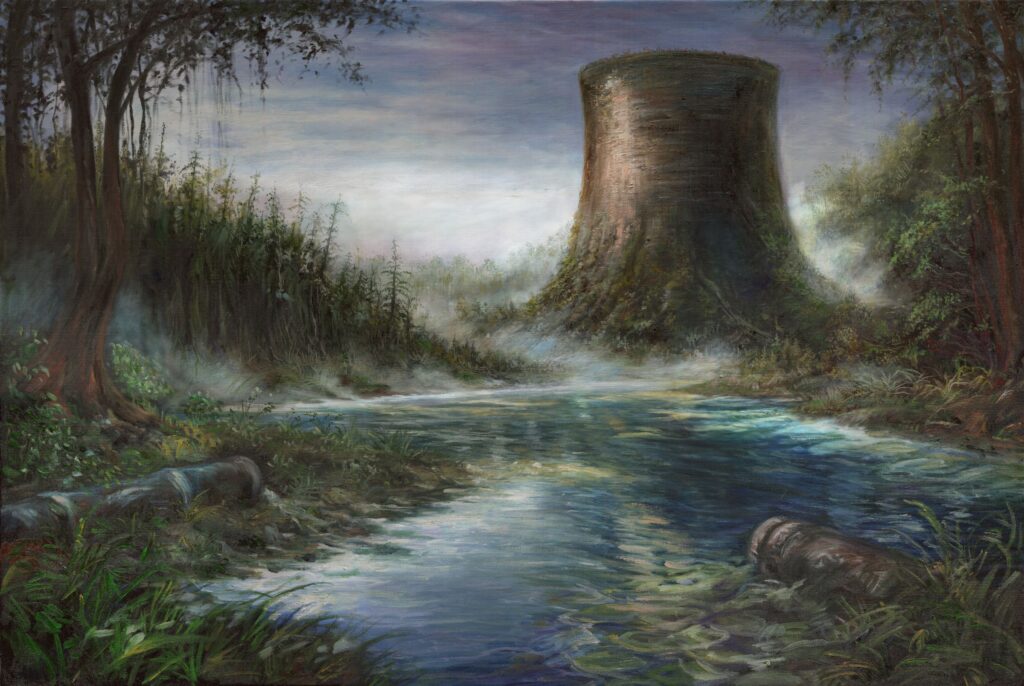
Systems Becoming Landscape examines how human-designed systems become part of the environments they occupy. Pipes, channels, utility networks, industrial structures, and ambiguous engineered forms enter coastlines, wetlands, fields, forests, and altered terrain, where water, vegetation, weather, and time transform their physical presence and original purpose.
The works do not present nature and technology as opposing forces, nor do they resolve change into progress or collapse. Instead, they consider how constructed systems persist, adapt, and acquire new meanings as they enter the longer material history of a place.
Developed through drawing, three-dimensional construction, AI-directed studies, and oil painting, the series approaches landscape as a record of continuing interaction between human design and environmental change.
Systems Becoming Landscape
Landscape is often treated as the setting around human activity. In this series, it is understood as the accumulated result of natural forces, constructed systems, changing use, maintenance, neglect, and time.
The works bring pipes, valves, channels, towers, utility networks, industrial structures, and ambiguous engineered forms into direct relationship with water, vegetation, sediment, weather, and terrain. Once installed, these systems do not remain separate from their surroundings. They redirect water, divide land, collect material, support growth, and establish new patterns of movement.
Over time, the distinction between system and landscape becomes less stable.
Systems in Longer Time
Infrastructure begins with an intended purpose. A pipe carries material. A channel redirects water. A power line distributes energy. A culvert allows one form of movement to pass beneath another.
The environment, however, continues to change after construction is complete. Water levels rise and fall. Vegetation accumulates. Materials corrode. Sediment alters drainage. Human needs and patterns of use shift. A system may remain active, be modified, become partially functional, or acquire a purpose different from the one originally intended.
The series examines systems after they have entered this longer condition. They are not shown only at the moment of construction or after complete failure. Their form and function are being altered through relationships that their original design could not fully determine.
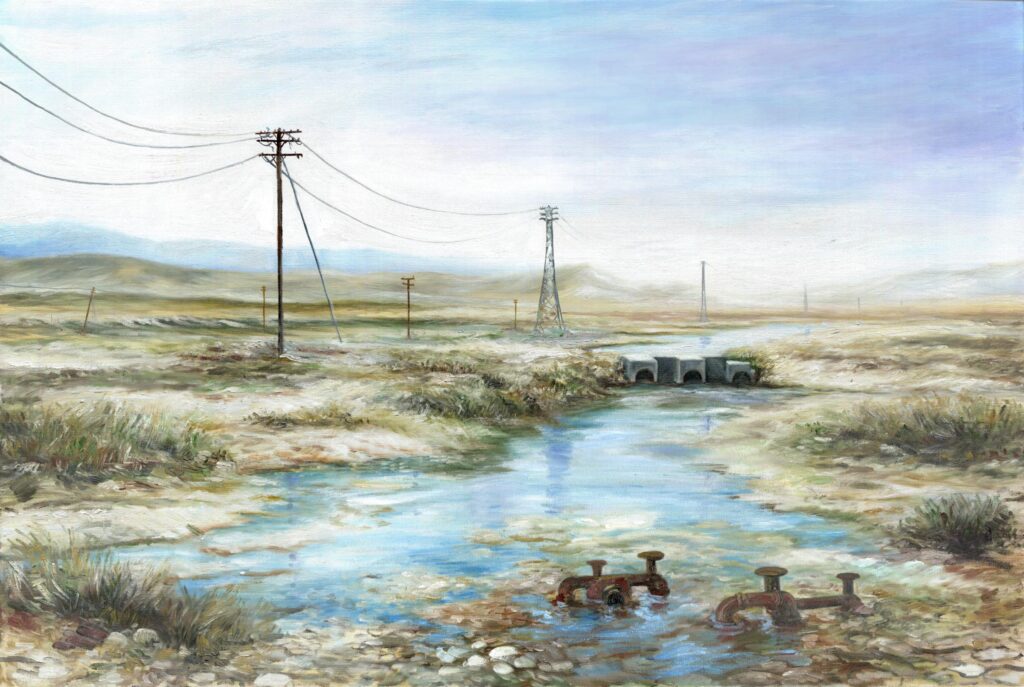
Nature does not simply surround these structures. It acts upon them. Water passes through constructed openings and collects around foundations. Grass, flowers, moss, and other growth obscure mechanical boundaries. Snow, erosion, atmospheric distance, and sediment change how structures meet the ground and how clearly they can be understood.
The structures remain designed objects, but they have also become part of the physical history of the places they occupy.
Changing Function and Meaning
A system can remain materially present while its original purpose becomes uncertain. This does not necessarily mean that it has failed. It may continue to operate, be adapted, serve a reduced function, or become part of another system.
The smaller pipe and valve environments concentrate this condition within dense mechanical arrangements. Water and vegetation enter their internal spaces, and the machinery begins to behave like habitat, organism, or terrain. The forms remain industrial, but they are no longer understood only through engineering.
The wider landscapes distribute systems across larger territories. Power lines, culverts, exposed valves, drainage structures, and channels become part of the organization of fields, wetlands, and industrial edges. These works emphasize that infrastructure is rarely an isolated object. It belongs to networks whose consequences extend across land and water.
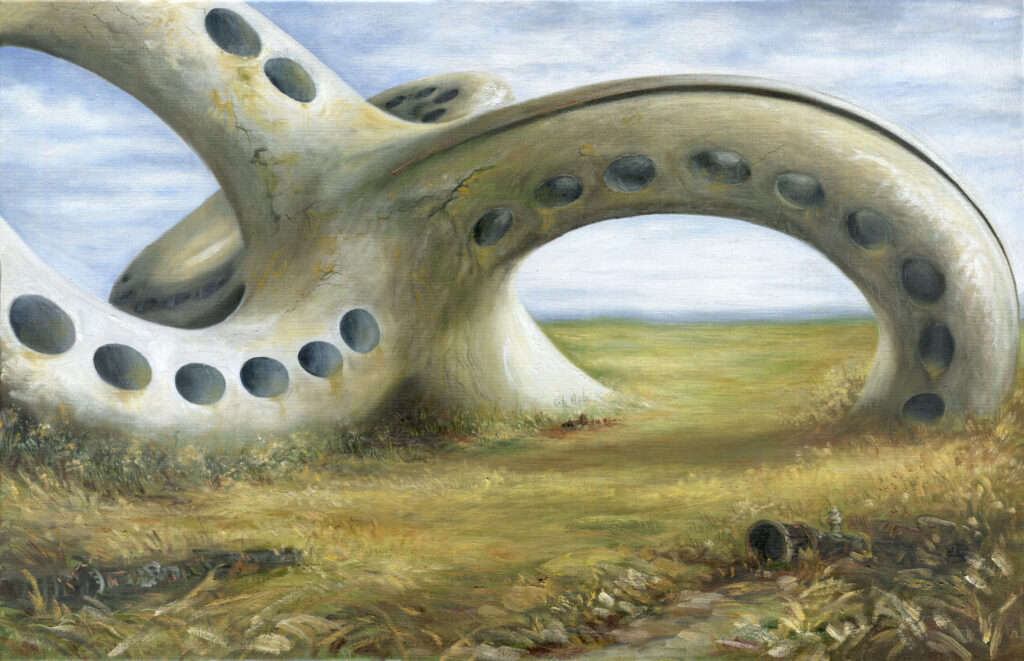
The monumental curved structures move the series toward greater ambiguity. They appear deliberately constructed, yet their use is difficult to identify. Their scale allows them to operate simultaneously as infrastructure, architecture, monument, and landform. Human design remains visible even when human purpose is no longer clear.
As a structure changes physically, its meaning also changes. Equipment can become architecture. Infrastructure can become monument. A mechanical form can begin to resemble geology or an organism. The work holds these readings together rather than resolving them into a single explanation.


Captions:
Moist Still Water, oil on canvas, 12 × 16 inches, 2025
Crosswind, oil on canvas paper, 11 x 14 inches, 2025
Coastal Sea Shore, oil on canvas, 24 × 36 inches, 2025
An Ongoing Condition
The weathered surfaces, uncertain functions, and absence of visible human occupation may suggest ruin or dystopia. The series, however, does not describe a world after a single disaster or the remains of a civilization that has ended.
It extends conditions already present in ordinary environments. Cities expand around older systems. Rivers reshape structures intended to control them. Industrial buildings acquire new uses. Agricultural, electrical, transportation, and water systems continue after the circumstances of their construction have changed.
The works are not organized around nature defeating technology or technology mastering nature. Constructed systems alter environments, and environments alter constructed systems. The resulting condition may involve adaptation, persistence, damage, continued use, or loss, but no single outcome is imposed upon the viewer.
Landscape as Record
The landscapes contain several forms of time.
There is the immediate time of weather, light, and atmosphere. There is the slower time of corrosion, plant growth, sediment, and erosion. There is also the cultural time through which structures gain, lose, or change meaning.
These durations occupy the same image. A structure may appear visually dominant while remaining materially vulnerable. A small pipe may imply a network extending far beyond the frame. A monumental object may remain intact while its purpose has become illegible. An ordinary channel may quietly reorganize an entire area through the movement of water.
Landscape records these consequences. It does not return to an earlier untouched state once a system has been introduced. Even when a structure disappears, the land may retain its channels, boundaries, altered vegetation, contaminated surfaces, or patterns of use.
The terrain is therefore not scenery. It is an active material record of continuing relationships between human design and environmental change.


Section caption: Temporal Originals examine constructed systems under changing conditions of climate, water, growth, weather, and time.
Captions:
Fog Over Wetlands | Digital Landscape (Blender)
Traveling | Digital Landscape (Blender)
After the Quite Season | Digital Landscape (Blender)
Constructing the Works
The series develops through drawing, three-dimensional construction, AI-directed studies, and oil painting.
Drawing allows mechanical and environmental relationships to emerge through line, repetition, and association. Three-dimensional construction establishes geometry, scale, and spatial consequence. AI-directed studies test structures under changing atmospheric, climatic, and temporal conditions. Painting introduces material resistance through opacity, transparency, surface, revision, and the physical accumulation of color.
These forms allow the same central relationship to be examined at different scales. A system may appear as an intimate mechanical cluster, a network distributed across territory, or a monumental form approaching the condition of a landmass.
The environments are constructed rather than discovered, but the method remains secondary to the subject. Its purpose is to determine whether a designed form can enter the landscape convincingly and carry evidence of duration, transformation, and material consequence.


Section caption: One constructed environment developed across drawing, structural construction, temporal study, and painting.
Captions:
Silent Morning | Digital Drawing | 2400×1604 – 300pixels
Seaside Nest | Blender Render | Spatial Build Clay
Seaside Nest | Digital Landscape (Blender)
Coastal Sea Shore | 11 x 14 inches | Oil on canvas
Systems Becoming Landscape
The title describes an ongoing process rather than a completed transformation.
A system becomes landscape when it can no longer be understood only through its intended function. It becomes part of the material, environmental, and cultural condition of a place. It affects what grows, where water moves, how land is divided, and how the terrain is later understood.
This transition does not erase human design. Pipes, channels, towers, and engineered forms remain visible. What changes is their relationship to everything around them.
Systems Becoming Landscape examines that relationship without determining whether it represents progress, collapse, adaptation, damage, or persistence. The works present the environment as the longer condition into which human systems inevitably enter.