Stage 1: Seeing the Landscape Before Everything Else
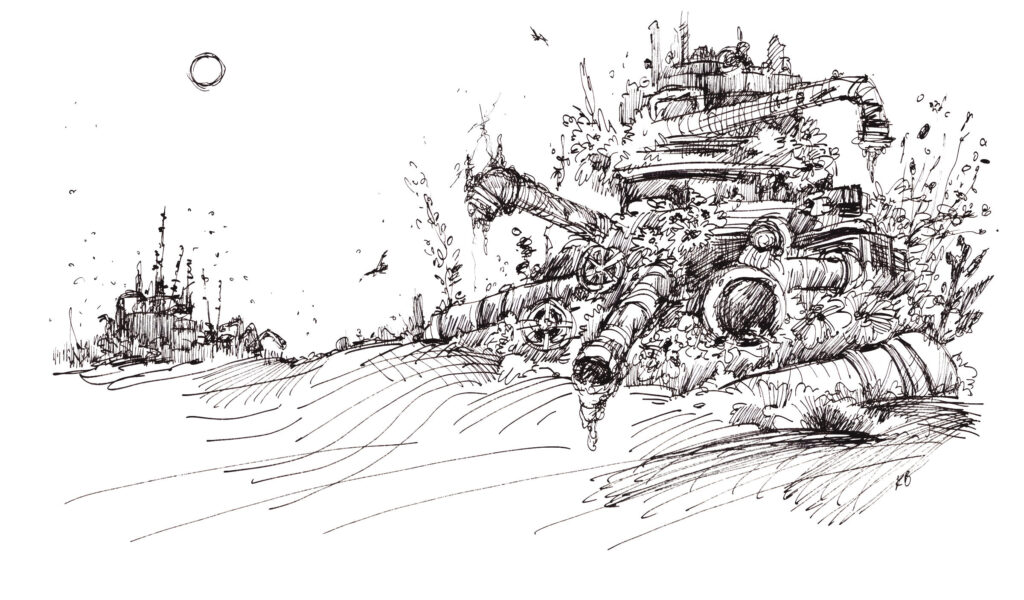
Over the past year, I have returned to the Great American Landscape tradition with a clarity that I did not have earlier in my practice. This return is not motivated by nostalgia or by a desire to revive an older mode of painting. It came from something much more direct: the need to rebuild my work from an observational foundation. After years moving through fast, concept-driven contexts—digital culture, contemporary art discourse, and the shifting roles of technology—I found myself needing to slow down enough to see again. Drawing provided that stillness. It allowed me to reconstruct my relationship to the landscape without noise, without performance, and without the pressure to interpret. Drawing became the ground on which my entire practice could reorient itself.
The Great American Landscape tradition has always been defined by clarity of attention. Its strongest painters understood the land not as a symbol, but as a record of time. In their work, distance, atmosphere, and light were not decorative elements; they were forms of knowledge. The land carried evidence of weather, history, and quiet change. Even when the scenes were idealized, the structure was built on disciplined observation. What strikes me about that tradition today is not its subject matter but its pace. These painters worked slowly. They felt no urgency to match the acceleration of their surroundings. In a moment when images move faster than we can process, that pace feels radical. Returning to it was a way to reclaim the kind of attention that contemporary culture rarely supports.
Drawing, in this context, is not a preliminary step—it is a way of seeing the world without interference. Before color, texture, or digital tools, drawing forces me to focus on structure: how land sits, how forms relate, how objects hold their weight. A line is honest. It cannot hide uncertainty. It cannot be softened by effects. When I draw, I confront the landscape at its most fundamental level. I observe the slope of a hill, the angle of a pipe, the shape of sediment gathering at the base of a structure. The drawing must hold together before anything else can. If the structure is unsound, the later stages will collapse. Drawing shows me what the landscape actually is—not what I want it to be.
Much of my work begins in the transitional spaces of the American environment—places where earlier use meets natural adjustment. These areas have always pulled me in. I am drawn to the quiet edges where human structures remain but no longer dominate, where plants gather around pipes, where soil reclaims older systems. These are not dramatic locations. They do not demand attention. They simply show how the world continues to reorganize itself. In these places, the land does not erase the past; it absorbs it. This is where my drawings begin—not with invention, but with the observation of how environments shift in subtle, unannounced ways.
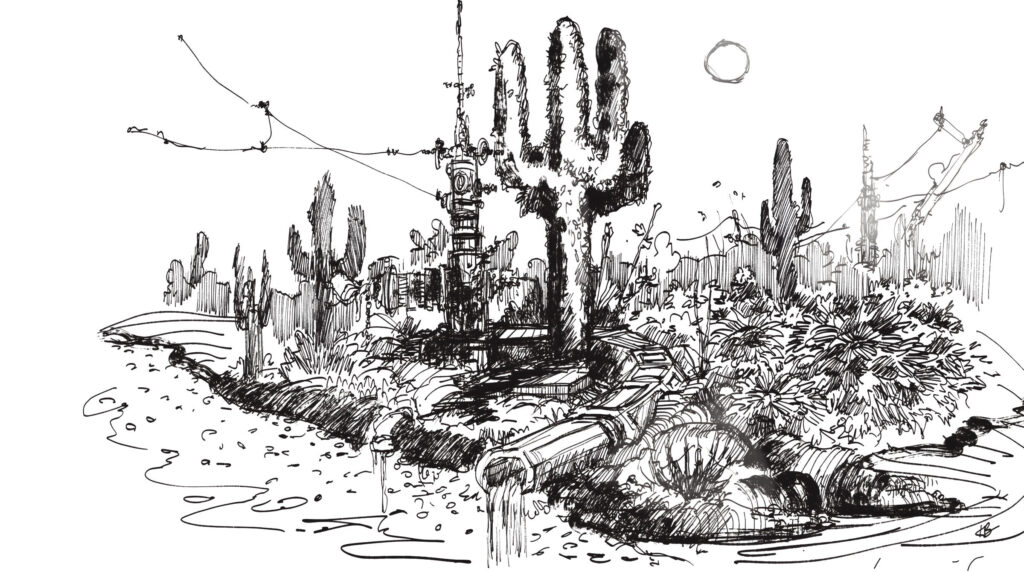
Because of this, the details I draw are not symbolic. Pipes, tanks, valves, and fragments of infrastructure appear frequently in my work, but they are not metaphors. They are objects that exist in the landscape as plainly as rocks or trees. In earlier eras, painters included barns, fences, or industrial structures without needing to explain their presence. I do the same in my own time. The difference is simply the nature of the objects we now leave behind. My drawings reflect the contemporary terrain—landscapes shaped by decades of use, decline, and rebalancing. When I place a pipe or tank into a scene, it is not a narrative device. It is part of the land’s memory.
The distinction between observation and illustration is important here. Illustration begins with an idea and arranges the world around it. Observation begins with the world as it is, or as it could naturally become, and follows its logic. I am not designing worlds. I’m documenting conditions. Sometimes the drawings appear spare; sometimes they read as quiet studies. That quietness is intentional. It mirrors the temperament of the landscapes themselves—places where change happens slowly, without spectacle, without the need for dramatic framing.
Drawing is the only stage where I can access this quiet with full fidelity. A line can express weight, pressure, erosion, or distance more precisely than color. With line alone, I can mark the difference between stages of growth, the density of sediment, or the particular way an object settles into soil. Light and atmosphere must be implied through the direction and sensitivity of marks, which forces the work to remain disciplined. Drawing demands that I understand the environment before I interpret it. That understanding becomes the structural spine of everything that follows.
The act of drawing also resists the speed that defines contemporary digital culture. We live in the presence of endless images—vast quantities of visual information that move faster than our capacity to absorb them. In this context, drawing becomes an anchor. It slows my perception until I can see the land clearly again. It returns me to a pace that mirrors the landscapes I depict. The land does not move quickly. Time accumulates gradually across its surfaces. Drawing allows me to observe that accumulation with patience.
Here, the Post-Globalist tone of my practice enters quietly. I am not interested in dramatizing collapse or presenting the landscapes as dystopian scenes. Instead, I see them as spaces shaped by long cycles—economic, cultural, and environmental—that are now settling into new phases. The remnants of those earlier systems are still visible, but they no longer drive the environment. Nature does not reject these forms. It incorporates them. The landscape does not tell a story of crisis; it shows the continuity of adjustment. This perspective shapes how I draw. I do not exaggerate. I do not stage. I observe where the land is going and follow its transitions without forcing them.
What drawing provides, above all, is orientation. When I draw, I understand where the weight of a landscape sits, where its balance lies, and how its elements relate. The drawing becomes a map of decisions. It shows me what to emphasize and what to release. It reveals the internal logic of the scene—whether a form belongs, whether an object should shift, whether the world holds together. Before I move into three-dimensional modeling or motion studies, I know the landscape intimately. I have touched every line, every edge, every adjustment.
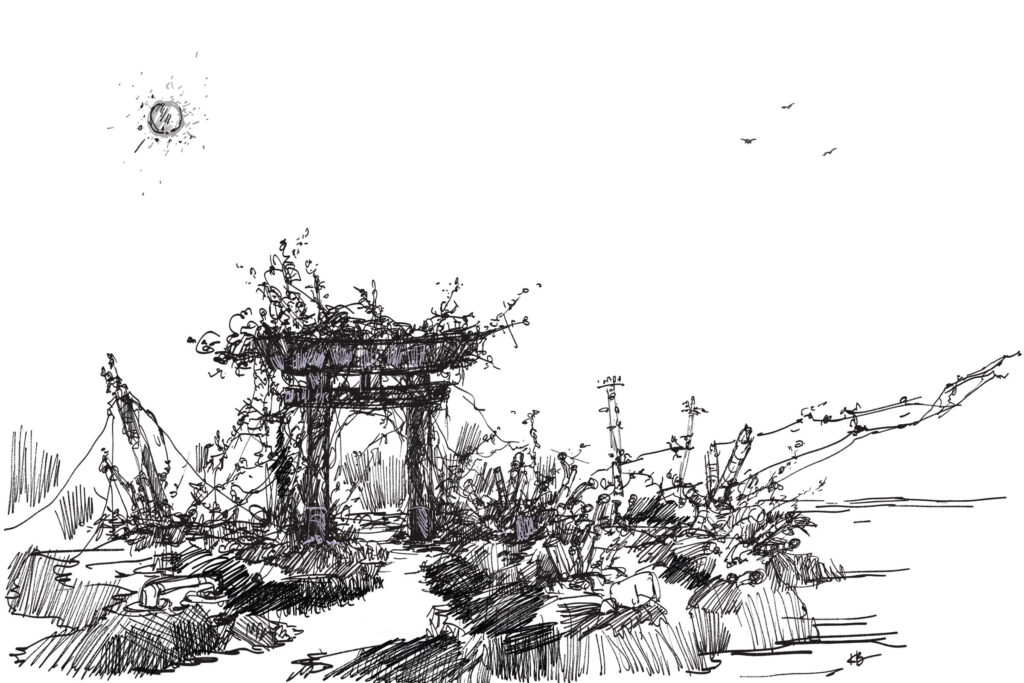
Even though drawing is the foundation, it is not the endpoint. After the drawing is complete, the landscape will move into a different phase, where I expand its forms into space using Blender. But that transition is not a shift in intention. Blender does not replace the drawing; it tests it. It ensures that the landscape can hold itself in volume, under light, under gravity. I mention this only briefly here, because the next essay will delve into that phase in depth. For now, drawing remains the clearest expression of how I see the world—a place where structure, attention, and restraint come together.
In this way, drawing is the core of my practice. It is where the landscape becomes legible, where its internal logic becomes clear. It is where observation becomes form. By the time the drawing is complete, the work has already revealed itself. Everything that comes afterward—structure, motion, painting—simply expands the understanding established here. Drawing connects the past to the present. It situates me inside the lineage of American landscape painting while allowing me to carry it forward in a manner appropriate to the environments of today.
Drawing is the beginning, but it is not a beginning in the sense of a starting point. It is the beginning in the sense of origin. It is where attention starts. It is where the land first speaks. And it is where I return, again and again, to understand the world with steadiness before I ask the painting to hold it.
KB