The Direction Provenance Model: Reclaiming Authorship in the Age of AI
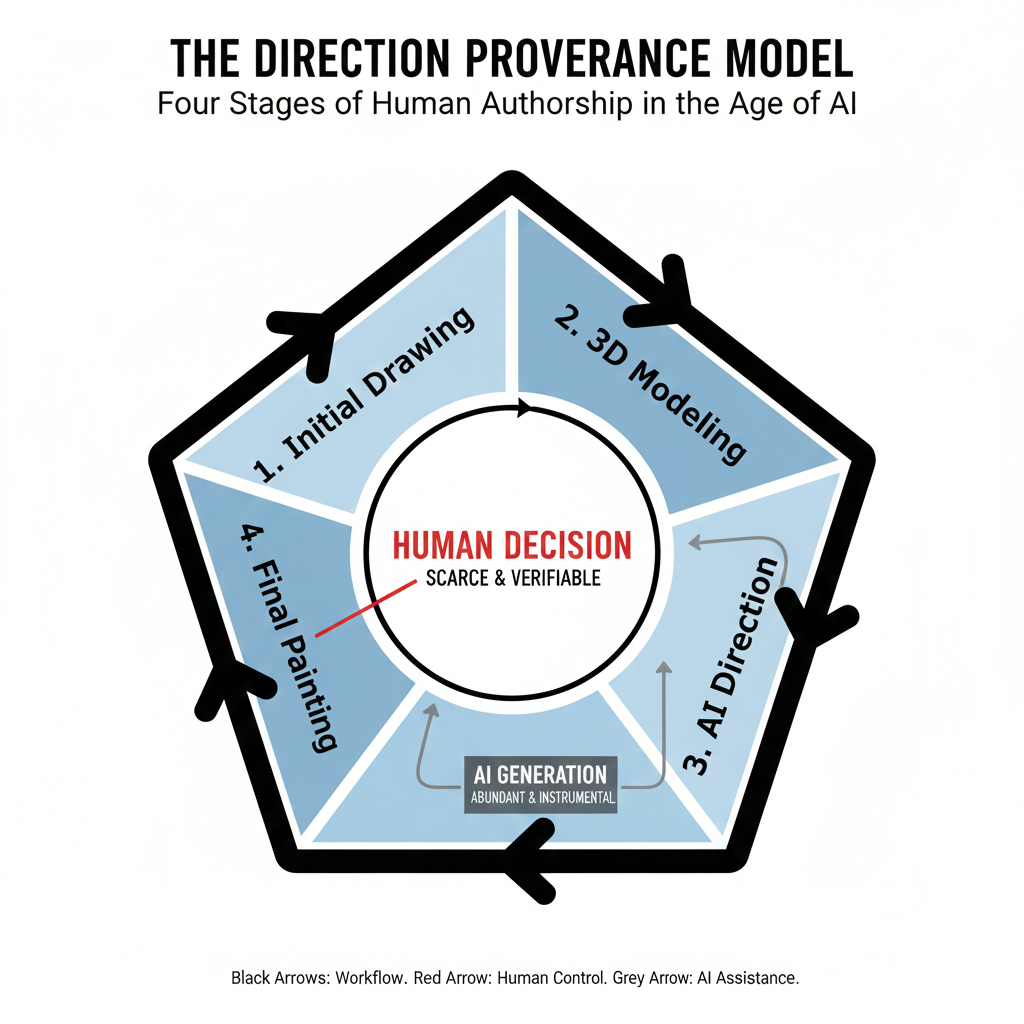
The advent of generative artificial intelligence (AI) has placed the art world at the precipice of a value crisis. In a landscape where digital creations—once considered rare—have become abundant, the foundational concepts of labor, provenance, and authorship are being questioned. Who truly owns work produced by a machine trained on vast swathes of human-created data? How can human agency be distinguished from the computational processes that now generate outputs indistinguishable from the work of individual artists?
The Direction Provenance Model offers a conceptual intervention to address this crisis, proposing a new, legally defensible standard for human authorship in AI-assisted creation. Developed through the Post-Globalist Landscapes series, which integrates hybrid physical and digital works, this model responds to over four years of work in the Bitcoin and crypto art ecosystem. It challenges the prevailing notion of AI as a co-creator, instead framing generative tools as abundant, instrumental resources whose artistic value is strictly subordinated to the human agency embedded in decision-making.
Reasserting Scarcity in a World of Abundance
The value of digital art, particularly within the NFT space, has long been tethered to the illusion of scarcity. Blockchain technology and tokenization were used to establish the uniqueness of digital assets. However, generative AI fundamentally disrupts this model by collapsing scarcity—outputs are instant, infinite, and often indistinguishable from human-made works.
The Direction Provenance Model does not seek to deny the abundance enabled by generative AI, but pivots the value equation away from the output itself, instead focusing on the intentionality behind its creation. The model asserts that human authorship is not defined by the volume of production but by the intentional direction and selection at critical stages of the artistic process. This framework shifts the conversation from mere digital output to the artist’s labor in guiding the process and the decisions that define the final work.
The theoretical foundation for this shift is explored in the accompanying text, “Art After The Last Economy,” where I argue that the value of art in the digital age is no longer derived from scarcity but from the ability to assert meaningful human presence in the creation process.
The Four Stages of Direction Provenance
The Direction Provenance Model formalizes a four-stage, cyclical process, ensuring that generative AI is positioned as a tool subordinate to human decision-making. The final work is the result of clear, verifiable human agency embedded in the work’s provenance, making human labor both traceable and essential to its value.
1. Initial Drawing
The creative process begins with a charcoal drawing or sketch—the first scarce, manual application of human labor. This preliminary act sets the unique directional foundation for the entire piece. It marks the first verifiable moment of human creative input and establishes the work’s guiding vision.
2. 3D Modeling
The initial drawing is then translated into a custom 3D model, crafted by the artist. This stage is informed by human decisions regarding form, light, composition, and texture, which further constrain the AI’s role in the next phase. Here, the artist’s formal decisions lay the groundwork for the subsequent use of generative AI, embedding conscious, formal scarcity into the piece.
3. AI Direction
At this point, the 3D model and initial drawing are fed into a generative AI engine, which synthesizes high-resolution variations based on the pre-established parameters set by the artist. In this stage, the artist is not simply providing prompts for arbitrary outputs; they are acting as a director, selecting the most resonant AI-generated variation. The artist’s role here is to exert their judgment over a wide array of potential outputs, making their selection the crucial artistic intervention.
4. Final Painting
The final stage is the translation of the selected digital image into a physical painting. This process is slow, manual, and transformative—emphasizing the human agency behind the physicality of the final object. The resulting painting is a unique, non-fungible physical object, offering the definitive material evidence of the human decisions that guided the earlier stages. This stage reasserts scarcity in its most tangible form and serves as the economic anchor for the entire provenance cycle.
Conclusion
The Direction Provenance Model is not merely a workflow; it is a philosophical declaration of human authorship in the face of radical technological automation. By defining artistic value as something derived from directional human labor—rather than mere volume or replication—it offers a clear, auditable framework for both artists and collectors to navigate the post-digital, automated economy.
This model’s emphasis on intentionality and scarcity in human decision-making provides a robust path forward for artists, institutions, and collectors seeking to preserve the integrity of human authorship and creative labor in an age of limitless generative output. In doing so, it moves the discourse beyond mere critique, offering a pragmatic solution to the challenges of value, ownership, and authorship in the age of AI.
KB
DPM: White Paper | Provenance | Proof of Public Record | Post-Globalist Studio contract: https://manifold.xyz/@kenneth-burris
White Paper PDF Download: Credit – Kenneth Burris @www.kennethburris.com