CORE STATEMENT OF INTENT
The Post-Globalist Landscapes mark a new chapter in my practice while remaining rooted in the same symbolic inquiry that has always guided my work. Earlier series explored figures, objects, and staged arrangements as carriers of meaning, while the landscapes shift this focus toward environment itself, ruins, pipes, fungi, tundra, and light as symbolic structures. What appears as a departure is in fact a redirection, with the older works now housed in the Kenneth Burris Studio Archives as the foundation for this new phase.
SYMBOLIC FIGURATION STATEMENT
The current figurative works place symbolic embodiment at the center of the composition. Figures appear within constructed environments—part ritual space, part cultural stage—surrounded by objects, patterns, and structures that reflect shifting values in a networked world. These works are designed to hold attention, offering a pause from acceleration while mapping how identity, technology, and cultural memory intersect. This series forms the connective tissue between the ecological narratives of No Time to Evolve and the still-life investigations of Code & Decay, carrying forward the same commitment to layered meaning and structural coherence.
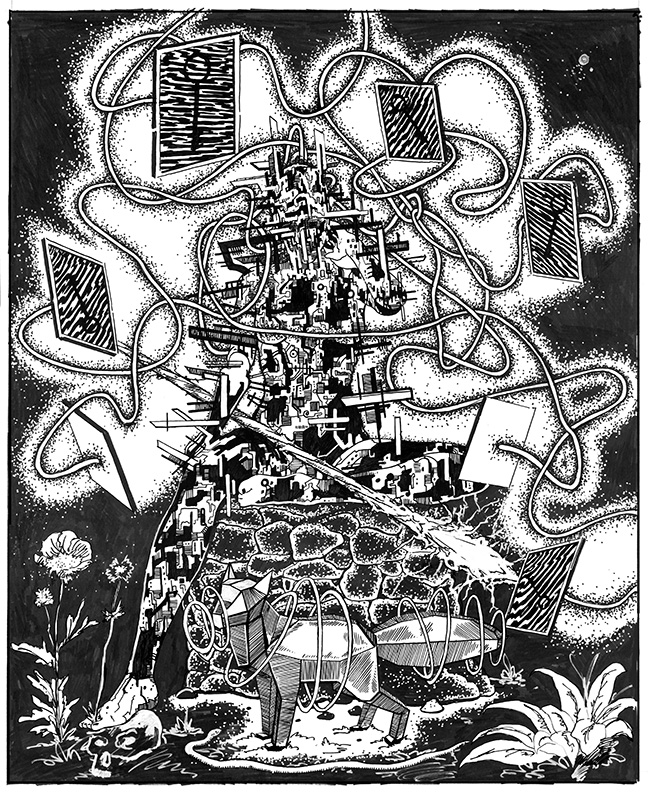
RITUALS AFTER COLLAPSE
Memory, thresholds, emotional stillness in symbolic worlds
Thumbnails: Frostfire Tales, The Puppeteer, Raft of Connectivity, Bridge of Lost Tribes, Smoke & Mirrors, After the System, Gorgon of the Grid.


TOWERS AND SYSTEMS
Ambition, belief, and broken mythologies in post-digital architectures
Thumbnails: Rush to Babel, The Order, Titan of Tech, A New Genesis, Weaver of Networks.


DIGITAL CARNIVALS & SYMBOLIC CHAOS
Spectacle, satire, and mythic dissonance in the hypernow
Thumbnails: Daisy Inferno, The Bitclown Brigade, Lemonade Dreamscape, Cypherpunks Evolution, Harmony of the Wild, Garden of Fur.


MYTHIC FRONTIERS
Heroic Archetypes, avatars, and spiritual identity in the decentralized age
Thumbnails: Sovereign Exodus, Uniting the Digital Frontier, Harmony of the Wild, Echoes of Wealth, Bridges of Lost Tribes, Gaia Rewired, The Data Weaver.


ALLEGORY OF VANITAS (Bridge Work)
Allegory of Vanitas extends my symbolic vocabulary into the visual language of vanitas. Instead of depicting dramatic change, the figure sits calmly among carefully placed objects that reflect on impermanence, value, and belief. Bones, coins, artificial plants, and fragments of technology are arranged not to express loss, but to question what still holds meaning within contemporary image culture. The figure appears as part artifact, constructed and reflective, positioned within a field of signs that suggest both history and design. As a bridge work, Allegory of Vanitas connects the figurative series with the still-life investigations of Code & Decay, marking a shift from symbolic embodiment to the study of physical and cultural traces.
CODE & DECAY STATEMENT
Code & Decay draws from still-life and vanitas traditions to examine how systems of meaning, value, and power shift in a networked world. Carefully rendered objects such as coins, bones, ledgers, artificial flora, and technological fragments are arranged in compositions that reflect on impermanence and transformation. There are no central figures; the focus turns to what is left behind, artifacts, arrangements, and structural remains that carry the weight of altered systems. These elements are not just markers of decline but containers of belief, suspended between preservation and erosion in a time shaped by digital memory and material disappearance. The series continues the symbolic inquiry of earlier works, moving from embodiment to aftermath, and asking what persists once narrative presence has receded.
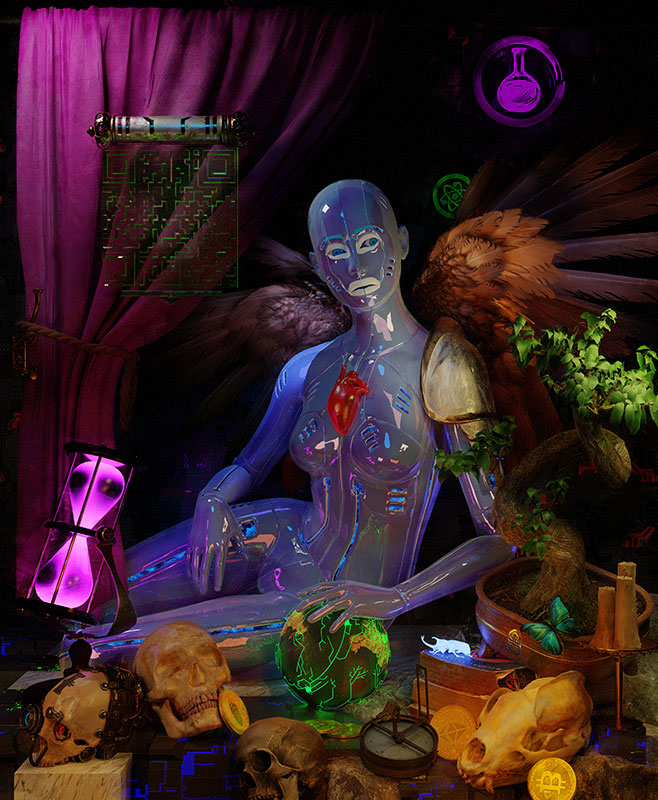
AFTER THE FIGURE
Still-lives that echo the absence of the body.
Thumbnails: Crazyass Honey Badger, Transient Treasures, Merging Boundaries, Time Hornet, Time of writing, Memory Locked.


