Art After the Last Economy
My paintings are a material response to the collapse of value outlined in the essay.
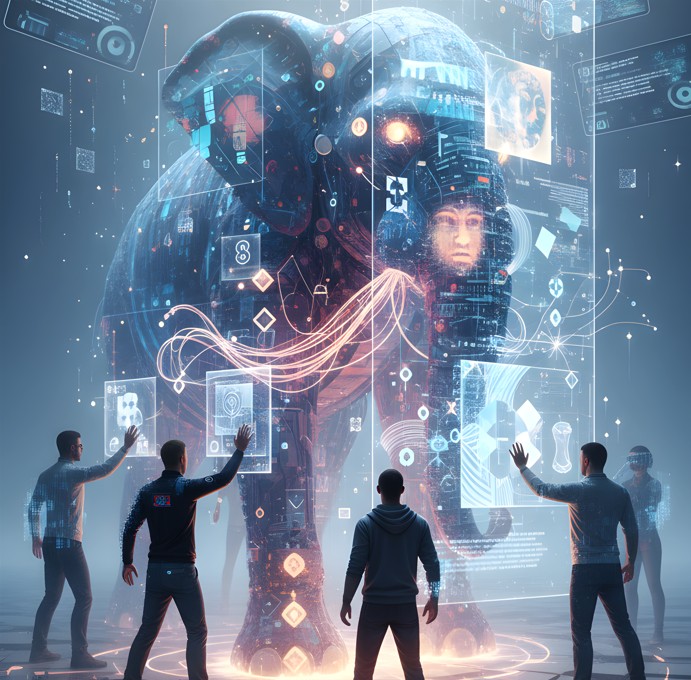
In The Last Economy, Emad Mostaque describes a transition toward a world shaped by agents, distributed intelligence, algorithmic coordination, and verifiable ledgers. His book sketches the architecture of the next system — how trust, value, and coordination will function once scarcity collapses. But the implications are not only economic. They reach into the interior of life: how attention works, how perception changes, how continuity is maintained, and what it means to make a choice when the world no longer requires humans to think.
I write this not as an economist but as an artist who has lived inside these thresholds long before they had names. I’ve painted through multiple technological shifts — from hand-painted billboards to digital production, from early blockchain narratives to the collapse of NFT spectacle, and now into the acceleration of generative AI. I’ve watched value systems dissolve and reform. I’ve seen authorship shift from craft into negotiation. Artists feel these changes before the broader culture understands what is happening.
This letter is not a promotion of artwork. It is a conversation with Emad’s ideas from the interior of practice — an attempt to articulate what artists will need to understand, and what they uniquely contribute, in an intelligent economy. And before anything else, I want to acknowledge a simple truth: I am biased. I write from the lived perspective of someone inside material practice and symbolic thinking. I am not outside the system. I am one of its subjects. This essay is shaped by that reality rather than attempting to hide it.
I should also make one thing clear: artists are not the only stewards of meaning, nor the only people capable of sustaining intention or continuity. Philosophers, teachers, organizers, technologists, and people working far outside the arts also carry forms of symbolic orientation. The difference is simply that artists feel these pressures earlier because our work sits closest to the symbolic layer itself. And artists are not immune to market incentives; many chase spectacle or scarcity just as the old paradigm encourages. My point is not that artists are superior, but that our position gives us a uniquely early view of what happens when the interior ground of culture begins to shift.
A Note on the Word “Symbolic”
Before continuing, it’s important to clarify what I mean by “symbolic.” I don’t mean symbols in the traditional sense — icons, motifs, allegories, or imagery that stands for something else. I mean something closer to orientation: the structure that allows a human being to make sense of their place in the world. Symbolic life is the framework through which coherence, direction, and continuity are held together. It is not about creating symbols; it is about sustaining the deeper architecture that symbols emerge from. In this sense, symbolic practice is not decorative. It is stabilizing. It is the interior scaffolding that lets a person — or a culture — know where they stand in relation to everything else.
The Intelligence Inversion
Mostaque argues that intelligence is no longer scarce. This is the core inversion his book outlines — cognition, once the most valuable human contribution, becomes abundant. Agents think, plan, interpret, generate, and act. The cognitive hierarchy collapses.
For artists, this shift does not feel like convenience. It feels like a loss of gravity. For centuries, value in art was tied to skill, effort, technique, time, and certain kinds of mystique. When intelligence becomes ambient, the old ground disappears. The question is no longer “What can you create?” because anyone can create anything. The real question becomes, “What remains when intelligence is automated?”
For artists, what remains is not skill or spectacle. What remains is orientation — the capacity to hold a position in a world that no longer requires humans to think but still requires someone to choose. The responsibility of the artist becomes remembering how to see when systems begin seeing on our behalf, and demonstrating that agency is still possible in a world where intention has become optional.
The Collapse of Old Economic Narratives
In mapping the lies of the dying paradigm, Mostaque names several assumptions that once defined how society created value. The idea that labor creates worth, that scarcity ensures meaning, that institutions regulate trust, and that productivity determines human value — all of these begin to break down when machines outperform humans across most cognitive activities.
Artists have already lived through this collapse. The NFT era dissolved scarcity. Viral spectacle eroded institutional authority. Value drifted away from objects and toward narrative, attention, and symbolic coherence. The last lie now dissolving is the idea that objects alone carry culture. They no longer do. In the intelligent economy, culture moves through systems of authorship rather than the objects themselves.
For artists, the task becomes revealing these collapses not as failures of culture but as failures of measurement, and guiding others into a world where value is no longer determined by scarcity but by continuity of intention — something automated systems cannot generate.
Alignment as an Embodied Experience
When Mostaque describes the alignment problem — how to ensure machines behave according to human values — he is addressing one of the largest ethical and political challenges of our time. But artists experience alignment directly, physically, in the body.
Every time an artist moves between intuition and acceleration, between slow material processes and fast generative tools, between symbolic meaning and computational prediction, they feel alignment as tension. Artists must hold onto something human as the system optimizes around them. Alignment is not abstract. It is a felt experience. And because artists understand limits, narrative, material resistance, and the consequences of orientation, they become prototypes for alignment, not through theory but through practice.
After Economics
Mostaque imagines a future where traditional economics dissolve, where labor no longer defines human value, and where productivity becomes a domain of machines. In that world, new forms of value must emerge. What is striking is that artists already live this way. Artistic practice has never been about efficiency or productivity. It operates on symbolic cycles that markets barely understand. In that sense, artists have been practicing “after economics” long before AI made it explicit.
If the rest of the world is moving into a post-economic age, then artists hold the blueprint for how humans might navigate it — not through objects or spectacle, but through continuity, orientation, and symbolic coherence.
AI and the Collapse of Perceived Production Value
AI doesn’t destroy production value itself — it destroys our sense of what production value is. Skill, difficulty, and technique lose their scarcity not because they stop mattering, but because AI makes the surface of difficulty easy to imitate. Conceptual art, once protected by the rarity of ideas, becomes exposed when models can generate infinite novelty. What remains is not the output, but the long arc behind it — the continuity of decisions that AI cannot replicate.
Materiality offers resistance, but not immunity. Many believe physical work is protected simply because it is physical. But as Emad’s book makes clear, materiality is reshaped when the cultural meaning of difficulty dissolves. A painting still matters, but for different reasons: not because it is rare, but because it carries the visible record of human continuity — the one thing an algorithm cannot fake.
In a world of infinite images, the physical object becomes a site of orientation, not automatic value. It is one of the last places where a viewer encounters slowness, friction, and a lived timeline that cannot be accelerated. The object no longer guarantees economic value. What it guarantees is coherence — a trace of a human being moving through time.
Why Blockchain Becomes Necessary
Once production becomes infinite and intelligence ubiquitous, the system requires a new architecture of stability. Blockchain — or any verifiable decentralized ledger — becomes essential not because of speculation or aesthetics, but because cognition is no longer the foundation of value.
When agents act, choose, generate, transact, and coordinate, we need a way to anchor identity, ownership, authorship, intention, and trust. Provenance becomes the last proof of human agency. In art, provenance has always mattered. In the next economy, it becomes structural.
Blockchain provides a public, tamper-resistant memory that does not depend on the institutions that may not survive the transition. It anchors the exterior system in the same way symbolic continuity anchors the interior. Artists hold one form of continuity. Ledgers hold the other. Both are necessary once scarcity collapses.
The Nature of Coherence
Coherence, as I’m describing it, should not be mistaken for a universal cultural alignment. In a fragmented, globalized world, no single symbolic framework can speak to everyone, nor should it. Coherence is not unanimity; it is integrity within a lived trajectory. It is the ability to sustain a position without dissolving into noise. Different communities, practices, or individuals will hold different forms of symbolic life. The goal is not to unify culture, but to preserve the conditions in which orientation remains possible at all.
The Missing Interior Cost
Mostaque maps the outer transformation — agents, abundance, compute, distributed trust. What he does not fully articulate is the interior cost. When intelligence becomes ambient, the first casualty is not labor but choice. When every decision can be optimized, the burden shifts from solving problems to sustaining orientation. Machines will generate images. Agents will plan. But only humans can hold a direction across time.
This is where artists become essential. We feel the thinning of symbolic life before it registers at the system level. We recognize disorientation early because we work inside the symbolic layer itself. The danger in the age of agents is not that humans disappear. It is that we become spectators in our own cognition. Artists become the counterforce to that drift.
Conclusion — The Next Symbolic Order
Mostaque gives us the system view. Artists offer the interior view. Together, they describe the next cultural condition. In the age of intelligent economics, the artist’s role is no longer to make images but to hold continuity when cognition becomes ambient, to maintain coherence when information becomes infinite, to model alignment when convenience dissolves intention, and to anchor symbolic orientation when time itself compresses.
Artists are not outside this transition.
We are its interpretive core.
KB