The Direction Provenance Model: Authorship in an Age of Infinite Supply
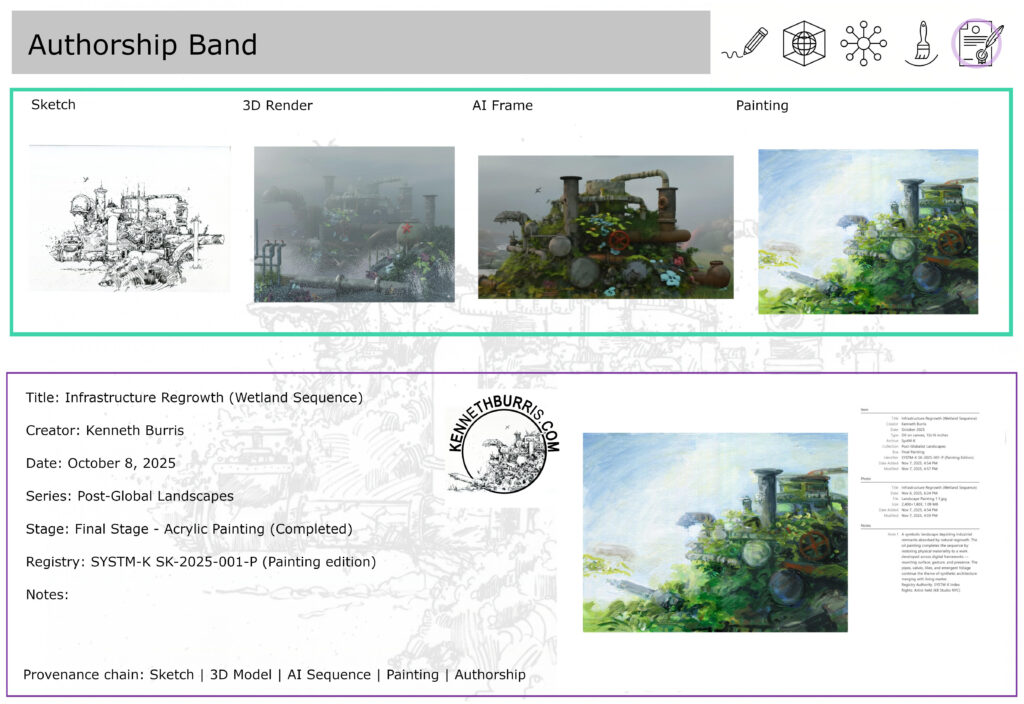
The Direction Provenance Model (DPM) is not a method of art production; it is a governance system for authorship in the age of generative abundance. It is built on a single, necessary premise: in a market where digital output is infinite, artistic value must be located in the scarcity of human directional labor.
The DPM acts as an intellectual architecture that fundamentally subordinates abundant digital technologies (like 3D modeling and AI synthesis) to the rigor and discipline of scarce human attention (drawing and painting). This four-stage model establishes an auditable, verifiable chain of decision-making that guarantees the integrity of the artist’s original intention, transforming a digital-era workflow into a defensible claim of authorship.
The Structural Necessity: From Abundance to Scarcity
Digital tools are characterized by ease and infinite possibility; they favor acceleration. The DPM is designed as a structural resistance to this acceleration. Every stage exists to impose consequence, commitment, and limitation—the very qualities destroyed by generative technology.
The result is a proprietary system that tracks the transition from the most scarce input (the initial drawing) to the most scarce output (the final, physical painting), while systematically neutralizing the risk of automation along the way.
The Four Phases of Directional Labor
The following four phases are detailed in their respective essays, each one proving the scarcity of human commitment necessary to control the process:
1. Initial Drawing: The Irreversible Source
This is the moment of pure, scarce human attention, rooted in the discipline of observational practice. The drawing establishes the structural and compositional truth of the landscape—the foundational weight and logic that cannot be altered in later stages without violating the DPM. It is the single, non-negotiable source of direction for the entire work.
2. 3D Modeling: Structural Verification
The digital environment (e.g., Blender) is utilized not for invention, but for rigorous verification. The human labor here is dedicated to testing the drawn forms against the laws of physics, confirming they hold together under weight and light. This phase imposes accountability on the initial structure, ensuring the work is grounded in verifiable reality before proceeding.
3. AI Direction: Selection of Time
In this phase of maximum digital abundance, the AI is constrained to function only as an “environmental laboratory” to test the duration and atmosphere of the verified 3D model. The creative act is the singular, irreversible selection of one perfect frame from an infinity of motion studies. This decision—the human commitment to a specific moment in time—is the crucial site of scarce authorship.
4. Final Painting: The Material Anchor
The process culminates in the final, manual translation onto the physical canvas. The painting represents the artist’s ultimate material commitment. Because the marks are irreversible and dependent on physical labor, the final object absorbs and proves the scarce attention of all prior stages. The painting stands as the economic anchor of the entire system, securing the DPM’s intellectual property in a singular, non-fungible physical form.
Conclusion
The Direction Provenance Model is the assurance that every artwork is an asset of verifiable human labor. By formally documenting and often tokenizing this structured methodology, the artist secures not just the copyright of the image, but the conceptual property of the process. For the verifiable blockchain record, the full history of the DPM is archived and made publicly accessible on the SYSTM-K Authorship Registry, guaranteeing its long-term integrity and value in the contemporary art market.
KB