Stage 3: AI Direction (Motion) — Duration and Selective Scarcity
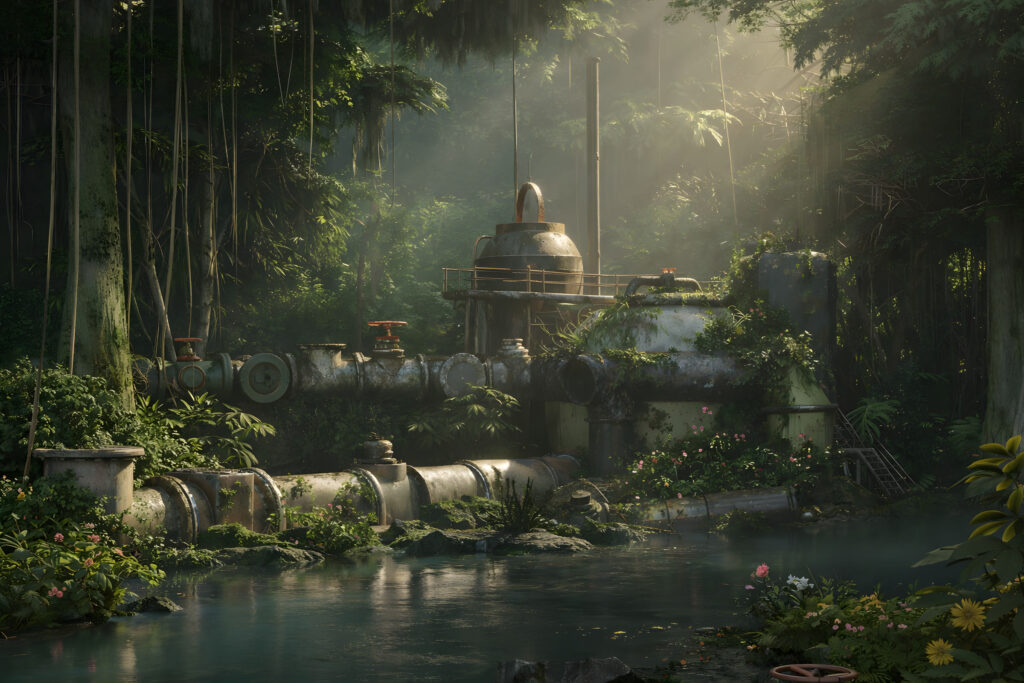
Drawing gives me the structure of a landscape, but it offers that structure in its quietest form—line, pressure, and the weight of observation. Once that foundation is set, the next phase of my process is to understand how the landscape behaves over time. This is where motion enters the process. I use AI motion tools not to animate scenes or create digital effects, but to study the most subtle qualities of an environment—how air moves across a terrain, how particles gather in light, how atmosphere shifts under different conditions. Motion adds time to the landscape. It tests the environment in ways that still images, no matter how precise, cannot reveal.
In drawing, I can understand balance and structure. In Blender, I can understand volume and weight. But in motion, I begin to see how the landscape breathes. A quiet drift of dust, a slow roll of fog, a slight pull of wind across long grass—these are small movements, but they tell me everything about the internal logic of the place. Movement shows me how soft or hard the air feels, how still or active the ground is, how light scatters across objects when the environment shifts. These observations become essential before I move to paint.
I do not use AI motion tools for spectacle. My interest is not in creating dramatic sequences or stylized animations. Instead, I use them as a kind of environmental laboratory, where I can test how atmosphere interacts with structure. If I introduce a slow-moving cloud of sediment into the space, I watch how it bends around a pipe or gathers at the edges of a slope. If I let light drift across the terrain, I pay attention to how the surface absorbs or reflects it over time. These small tests reveal tonal relationships I could not fully understand through static rendering alone.
Motion, in this sense, is another form of drawing. The line is replaced by behavior. Instead of tracing a contour, I trace how a shadow shifts by a few degrees. Instead of marking a direction with graphite, I watch how wind pulls in a consistent path. These studies show me which parts of the landscape are solid and which parts need adjustment. They refine the decisions I will carry into the final painting. Motion confirms whether the world I built in structure can withstand the slow pressure of time.
What matters most to me is that the motion remains grounded. I am not creating environments that exceed the world’s natural behavior. I am studying the kind of movement that could happen today, in familiar terrains—fields, shorelines, industrial edges, transitional spaces where nature absorbs what remains. The AI tools are not a creative identity in the work; they are simply a way to observe patterns that would otherwise unfold too slowly to capture. They let me compress long durations into watchable moments, not to accelerate the process, but to understand it more clearly.
This phase resonates closely with the Post-Globalist tone of my practice. I am not using motion to dramatize collapse or imagine distant futures. I am watching how landscapes adjust after long cycles have slowed—how systems age into the background, how wind and weather reclaim surfaces, how small movements carry the memory of earlier forms. These are not apocalyptic gestures. They are quiet truths. The motion phase allows me to see these truths with more precision than static observation alone.
Motion is not an effect. It is not an aesthetic layer. It is a study—one that deepens the landscape’s presence before a single brushstroke is made. It gives me a sense of the environment’s internal rhythm, the slow adjustments that define a place over time. By the time I reach the painting phase, I have seen the environment under different conditions—dry, damp, warm, cool, still, and in motion.
This is the ultimate function of Stage 3 in the Direction Provenance Model: I select one single, high-resolution frame from the infinite range of generated temporal output. That single, chosen frame—the product of human judgment and selective scarcity—is then finalized for translation into the physical painting. Motion gives duration, and selection gives definitive human authorship.
KB